
Hacía ya varios años que secretamente deseaba ir a Burning Man, mítico evento boreal que se lleva a cabo cada Septiembre en el desierto de Nevada. Alli se mezclan expresiones artísticas de toda naturaleza con la naturaleza misma: esculturas, performance, música, silencio... y polvo, viento, lluvia, barro, sol implacable y luna chamánica. Nueve días con sus noches de rituales paganos, donde los 70.000 habitantes de una ciudad temporal erigida exclusivamente para celebrar el lado mas brillante de la humanidad se mueven de un lado a otro en bicicletas, motos eléctricas y carrozas de gran esplendor.
Burning Man, con su colosal y desinteresada autoridad, simboliza el lado idealista de la generación posmoderna, tal como Woodstock definió el espíritu libre de los '60 y el glam/punk rock el desencanto y decadencia de los '70. La posmodernidad abarca mas de una década, siendo los '80 su punto más álgido, después que los movimientos sociales de masas implosionaran ante el advenimiento del capitalismo pop: yuppies, el new-wave, la arquitectura de escala inhumana, el sueño americano de prosperidad y un consumismo insaciable engendraron una sociedad occidental llena de sonrisas falsas, ingeniosas publicidades y una pastilla para cada problema. La libertad ante todo, pero separados. El individualismo como rey, la colectividad como dogma anticuado, que evita el avance supersónico hacia las estrellas. Y así nos estrellamos: crisis climática, petroguerras, polución, alimentos cancerígenos... la inteligencia artificial que asoma para aniquilar primero nuestros empleos y luego a nosotros.

La respuesta temprana a ese estado de híper-superficialidad la dió un grupo de bohemios californianos en 1986, quienes con la quema del primer "Man" en una playa de San Francisco iniciaron inadvertidamente un movimiento que pronto se dió a llamar "Burning Man" y cuya esencia radica en la solidaridad, la expresión irrestricta y la autosustentación extrema. En Burning Man no existe el dinero. Todo se comparte y no hay límite a la imaginación. "The Burn" se mantuvo como ceremonia cuasi-íntima hasta 1990, cuando se mudó a la locación actual, un paraje desolado conocido como Black Rock Desert. Allí se desarrolló anárquicamente hasta 1997, año en que se impusieron las primeras reglas: no animales (se escapaban a la montaña) y no combustible líquido ni pirotecnia (riesgo: explosivo). Con el correr del tiempo, este curioso experimento social creció en popularidad y se vio obligado a organizarse de manera "seria" para así poder recibir una creciente cantidad de burners y continuar ampliando su impacto (contra)cultural.
Por más que en Burning Man el dinero no corra, las entradas son caras. Van de $550 a $3000 dólares -según cuándo se saquen y cuánto uno esté dispuesto a colaborar con la causa- se agotan fácilmente y no es tan simple conseguirlas. Aun con entrada en mano, acceder al evento presenta una dificultad extra, ya que se lleva a cabo en un paraje remoto, sin agua dulce y escasa lluvia anual. Conducir hasta allí es toda una travesía. Además, hay que tener disponibles varios días de ocio sin conexión a internet, la cual escasea. No es posible (y se desalienta) el teletrabajo desde Black Rock City, portentoso nombre de una ciudad que se levanta en cuestión de días para luego ser totalmente desarmada en tantos otros, dejando cero huella de su existencia.
Sabiendo esto, me adentré en la aventura ya convertido en hada, tal es el nombre que se les da a quienes experimentan Burning Man por primera vez.

Aunque es una ocasión que muchos consideran ideal para probar sustancias que alteran la percepción, yo justo caí enfermo unos días antes, por lo que pasé todo el "Burn" completamente sobrio. Esto me dio la oportunidad de apreciar los acontecimientos con total claridad. Un amigo fueguino me pasó a buscar con su novia por el aeropuerto de Reno pasada la medianoche y enfilamos rumbo al desierto. En los últimos kilómetros solo se veían estaciones de servicio destartaladas, azotadas por el viento. Entrada la madrugada llegamos a la cola, donde decenas de autos, camionetas y casas rodantes aguardaban su turno para ingresar al predio. Afuera, una tormenta de polvo arremetía sin piedad. La visibilidad era casi nula. Parecía otro planeta. Después de tres horas, nos dieron la bienvenida. Amanecía.
Entrar a Black Rock City es meterse en una ciudad alternativa. ¿Otra dimensión? Está dispuesta como una perfecta medialuna, cada vehículo tiene su lugar asignado, hay calles demarcadas y se nota que la gente va súper preparada para habitar un sitio inhóspito, donde hasta los bichos son pocos. Lo llamativo es que cada habitante está en modo de constante expresión. Lo primero que captó mi atención fue una chica trepada a un sapo gigante, contemplando la salida del sol. Luego noté una carpa de circo cuyo cartel exterior rezaba "Orgy Tent"... la mayoría aún dormía, pero la realidad se veía como un sueño.
Dia 1
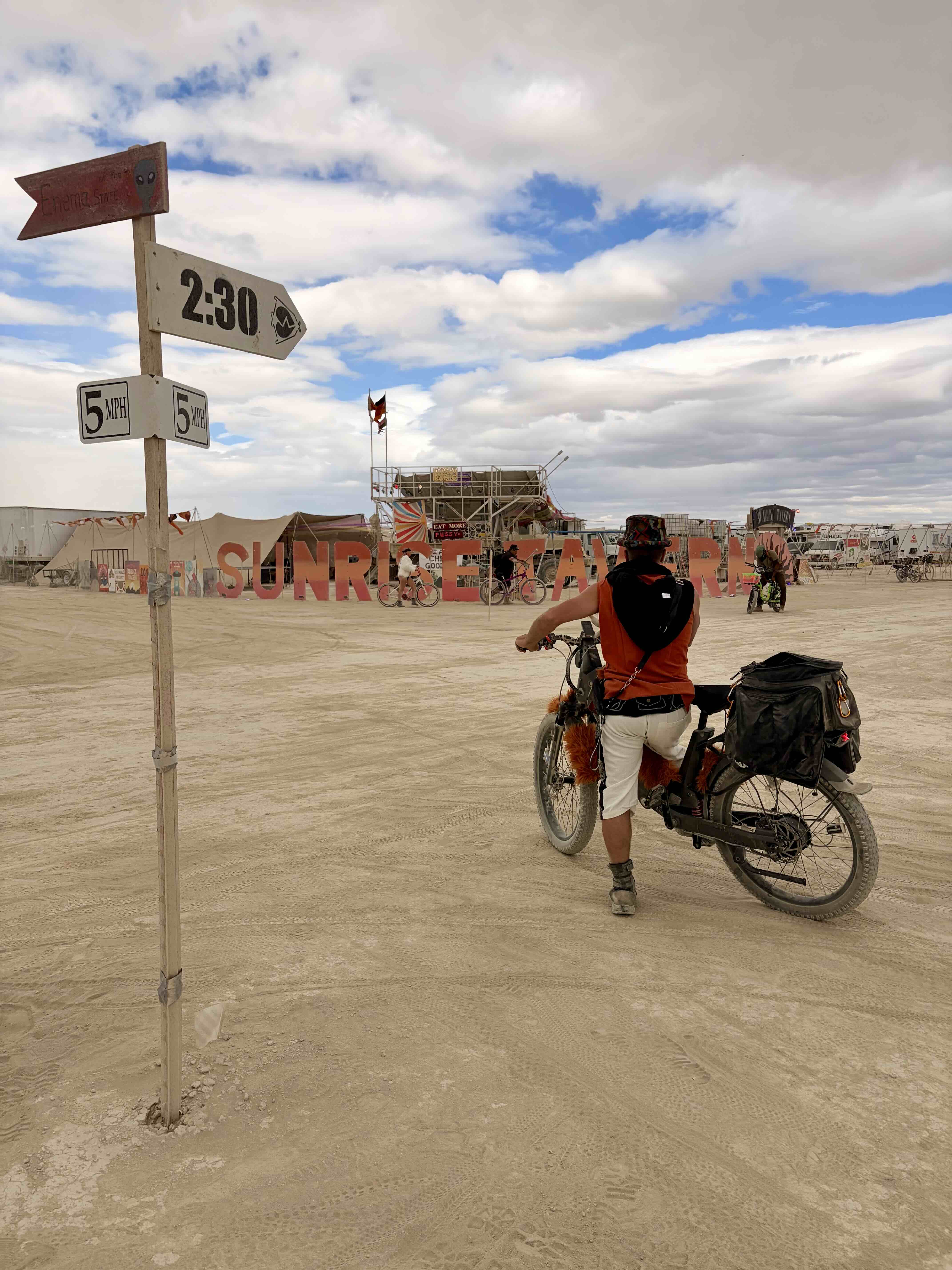
Aproveché la mañana para armar la carpa en mi "camp", donde ya me esperaba un grupo de amigos. La edad promedio en BRC es de 34 años, pero hay gente de todo grupo etario e incluso familias. Lo primero que hice fue agarrar una reposera, ubicarla en la esquina y sentarme a observar el increíble desfile de personajes, bicicletas y carrozas que pasaban por ahí. Aunque confieso que he viajado, esta no era una esquina cualquiera. Después de un par de horas, salimos a dar una vuelta. A la cuadra, descubrimos una carpita donde se servía la bebida de moda: matcha. Ya que no existe el dinero, uno solo debe acercarse al "mostrador" y, con la diligencia propia de un lugar donde el reloj se usa poco, hacer el pedido. Un dúo de djs baristas amenizaba la tarde. Divino.
El viento no cesaba y de hecho se intensificaba. Volví al camp y me preparé para salir. En realidad no hice nada, ya que me quedé con la misma ropa polvorienta que tenía encima. Ducharse es un lujo para pocos en BRC. Además, no se puede derramar ningún tipo de líquido. Tampoco hay tachos: los deshechos debe volver al "mundo default" con la persona que los generó. Al anochecer me pasó a buscar la pareja con la que llegué y pedaleamos juntos hasta una de las tantas fiestas. Los atuendos nocturnos son un show aparte, teniendo en cuenta que la temperatura baja considerablemente: sacos de piel sintética, sombreros fedora, pañuelos, animal print, trenzas ceñidas para ellas, pulseras metálicas para ellos, lucecitas para todos (si no llevás luces encima, te gritan "¡dark bug!" -bicho oscuro-). La onda general va de minimalismo retro a maximalismo futurista, sin escalas. ¿Mi look? Poncho salteño rojo, galera negra, alpargatas y máscara pandémica para protegerme del polvo. Bailé un rato, pero el cansancio del día me pudo y pronto me fui a dormir.

Dia 2
Me levanté temprano con música al palo. Justo enfrente habían montado una carpa con djs. Me crucé y durante un rato fui el único bailarín. El viento había amainado un poco, pero el polvo hacía que el aire fuera casi irrespirable. Todos tenían sus modelos de máscaras, algunas mas sofisticadas que otras. Después de compartir un almuerzo magro aderezado con polvillo altamente alcalino (BRC se erige sobre suelo prehistórico), me subí a la bici y fui a recorrer la efímera urbe. Pasé por barcitos improvisados, una esquina con micrófono abierto donde cada uno podía cantar o recitar lo que le plazca, por una instalación llamada "Barbie Death Camp" (??!!) y muchos camps armados de las maneras mas inventivas, desde carpas militares a cubículos plateados que parecían destinados a la exploración lunar. Me sumé a una reunión de "Burners sobrios" -yo era uno, aunque de manera forzada- donde escuché testimonios loquísimos hasta que vino un "guardaparque" y nos comunicó que se acercaba una tormenta de polvo (¡Desert Storm!). Todos inmediatamente se levantaron, montaron sus bicicletas y se marcharon raudamente. ¿Qué se avecinaba?
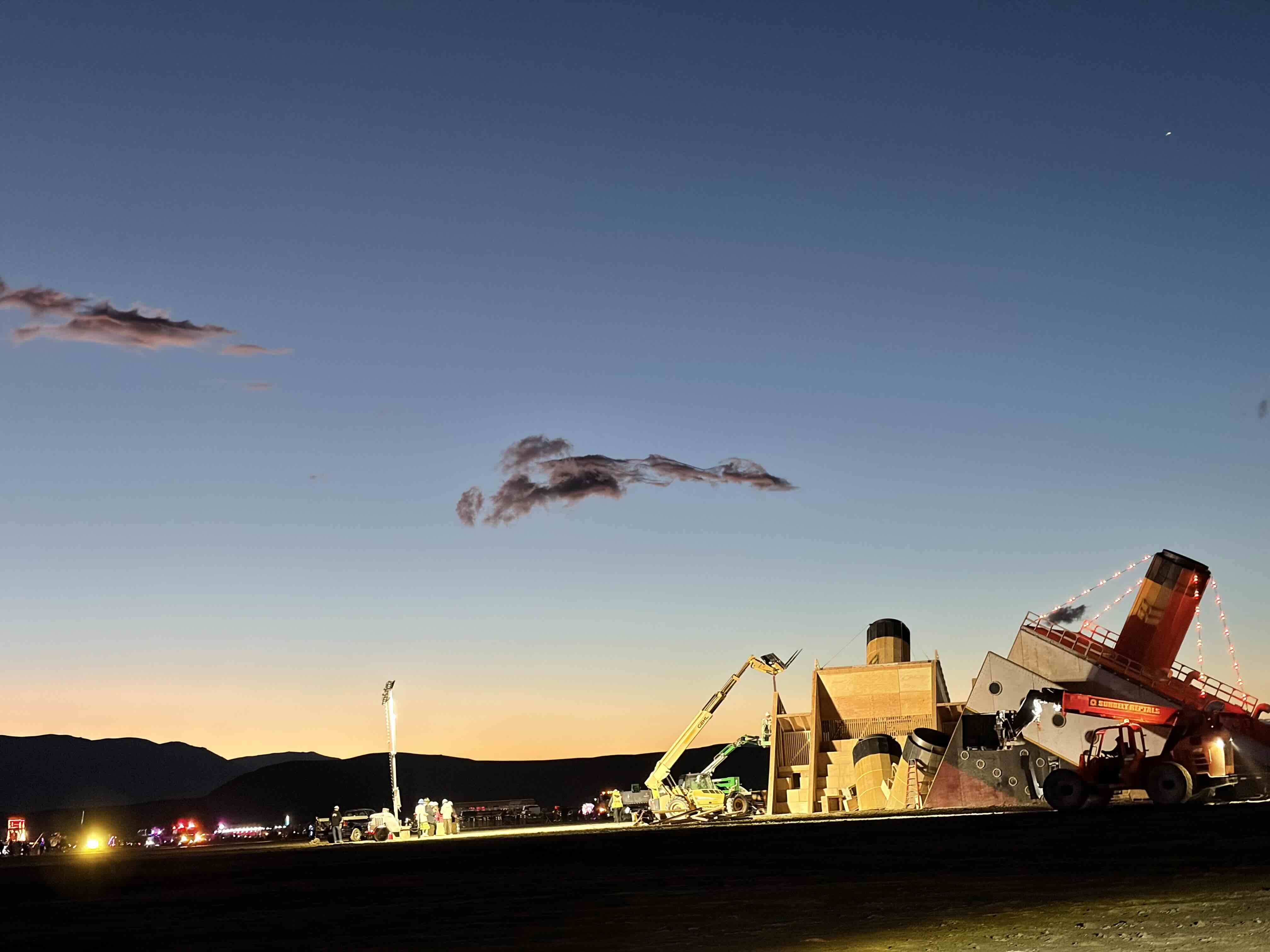
Al atardecer y luego de la tormenta (fue leve), mi chamigo y su princesa pasaron a buscarme nuevamente, esta vez con una linga, la cual usamos para atar mi bici a su moto eléctrica. Fue así que me remolcaron por toda la playa (se pronuncia "plaia"), el espacio abierto frente a BRC, donde se desarrollan la mayoría de las fiestas y donde se levantan instalaciones artísticas de grandes dimensiones. Éramos el foco de atención. De más está decir que había cosas muy llamativas, como el Titanic y la Torre Eiffel (ambos partidos al medio), pero esa tarde el ingenio de mi guía se llevó todas las sonrisas de aprobación. Nos adentramos en territorio desconocido, donde cabinas de dj móviles expedían música electrónica de géneros variados, aunque el house y el tech-house eran los sonidos predominantes. Ya de noche, empezó a garuar finito. Al rato, lloviznaba. Decidí marcharme mientras aún tenía fuerzas, sabiendo que pedalear en el lodo iba a ser arduo. No estaba equivocado. Hice dos paradas antes de llegar a "casa": en un elefante psicodélico que me resguardó del frío y en el bellísimo "Templo", construído íntegramente en madera en honor a las personas que queremos y ya no están. Nuestros deseos, frustraciones y amores se dejan ahí, para que el fuego los arrulle la última noche del Burn, cuando esa estructura de arquitectura singular se convierte en cenizas... Finalmente llegué, me acosté y enseguida empecé a escuchar las pesadas gotas de lluvia que caían. Cerré los ojos.
Dia 3
Me desperté y aún llovía. Nuestros vecinos ucranianos dándole play al mismo tema de Foster The People en repeat. Salí de la carpa y ya no había polvo flotando, pero era un barrial. Cuando se mezcla con el agua, el suelo de BRC se transforma en un fango pegajoso, difícil de quitar. La gente cubría su calzado con bolsas de nylon. Nadie estaba realmente preparado. Al no poder transitar, los camiones atmosféricos dedicados a vaciar los cientos de baños químicos de la ciudad tampoco podían hacer su ronda matutina... Siguió lloviznando toda la mañana, hasta que al mediodía comenzó a aclarar.
Fue entonces que se apareció un hombre de poncho, sombrero y escoba en mano para ayudarnos a sacar el agua acumulada en la lona del techo. Asistido por su escoba, lo hizo rápido. Era uno de los pocos con botas. -"¡Ud. parece un gaucho!" -le dije- "Este es un accesorio gaucho"- respondió, al tiempo que nos mostraba un pañuelo de cuello inequívocamente pampeano. -"Una vez fui a Buenos Aires a aprender fileteado"- ¿Coincidencia? Enseguida eché mano a un block de hojas, un marcador y le pedí que improvise uno. Se sentó y, mientras dibujaba, nos empezó a relatar su historia. -"He estado en todos los Burn. Soy parte del grupo que dió origen a la idea, allá en San Francisco"-. Los integrantes de nuestro camp comenzaron a reunirse en torno a Justinian, tal era su nombre. "En los '90 estuve de gira con Trent Reznor. Hacía un número de contorsión en medio del show. Lo pueden ver en YouTube como 'The original armenian rubberman Justinian Morton'". Narrador nato, fue él quien nos contó como fueron los primeros Burn y como el año 1997 marcó un punto de inflexión, siendo el último sin reglas. -"En esa época éramos solo 15.000"-, explicó. -"A todos siempre les digo, acérquense a los camps más sofisticados y usen sus bonitos baños, ya que el espíritu de Burning Man está en compartirlo todo"- El hombre exhudaba humildad, predicaba enseñanzas. Un maestro -"El favor que nos hizo se llama gauchada"- le dije. "Anótamelo por favor, colecciono palabras". Se la escribí en su teléfono celular mientras finalizaba su fileteado, el cual decía 'GAUCHO'". -"Tiene lindos firuletes"- le expresé. "Anótame esa también", me indicó después de explicarle el significado. Y se marchó, agradeciéndonos por haberlo escuchado, casi agradeciendo por haberlo dejado hacernos un favor. La simpleza y magia de ese momento evidencia la resistencia que existe hoy hacia a los tecnócratas de Silicon Valley ("tech bros"), quienes comenzaron a asistir -mas que nada como observadores- hace aproximadamente una década con el boom de sus imperios en la nube, trayendo consigo el super lujo y la exclusividad a un espacio que siempre se consideró egalitario, salteándose el esfuerzo cotidiano que es parte esencial de la experiencia.

Al calmar la lluvia y salir el sol, el lodo se secó en menos de una hora. ¡Ya no había polvo!, ¡ni viento! La fiesta enfrente se desataba con aullidos post-diluvio. Las bicis iban y venían. BRC entraba en modo activo. Aproveché y salí. Hice un par de cuadras y me encontré con una carpa discretamente llamativa: "Café Morocco". Escuche música y entré. Lo que descubrí fue la epítome del chill-out. Sillones, almohadones, alfombras, slow-tempo y café, acompañados de voces femeninas e intrumentos que improvisaban sutilmente sobre el dj. No éramos tantos, pero estaba lleno. Descalzos. Pronto me di cuenta que era una "camp party". Todos se conocían, menos yo. Felicidad de media tarde. Al salir de ese sueño norafricano, la noche se relamía.
Me fuí a preparar (solo me puse el poncho) y nuevamente los novios pasaron a buscarme. La playa vibraba, las estrellas asomaban. Fuimos en busca de Monolink, que tocaba en la carroza Robot Heart, el camp mas famoso, tanto por los djs que lleva como por su nivel de hedonismo. Estaba lleno. Esperamos. Y esperamos. Y esperamos. El artista estaba ahi, en la cabina, rodeado de campers, pero después de una hora, nada. Un poco desilusionados, pedaleamos hasta otra fiesta. El panorama nocturno de la playa es puro neón que se pierde en el horizonte. Bicis, gente, carrozas... todo está iluminado, un espejismo multicolor. La música de las carrozas se confunde entre sí. Me recordó un poco a Creamfields y ese caos de beats y tránsito de clubbers. Fiesta, fiesta, fiesta. Camino a casa subí un altísimo tronco de árbol con una casita en la punta. Me senté en una hamaca y vi salir la luna roja, dominatrix estelar de ese paisaje surreal. Todos parecían estar bajo los efectos de algo, menos yo. Observé atentamente The Man, la efigie de un hombre erguido sobre una plataforma de 40 metros en el centro de la playa. Sirve de guía, ya que mira de frente al medio exacto de la medialuna que conforma BRC. Seguí sus ojos y me fui a dormir, cansado de pedalear en el barro rugoso y solidificado.

Día 4
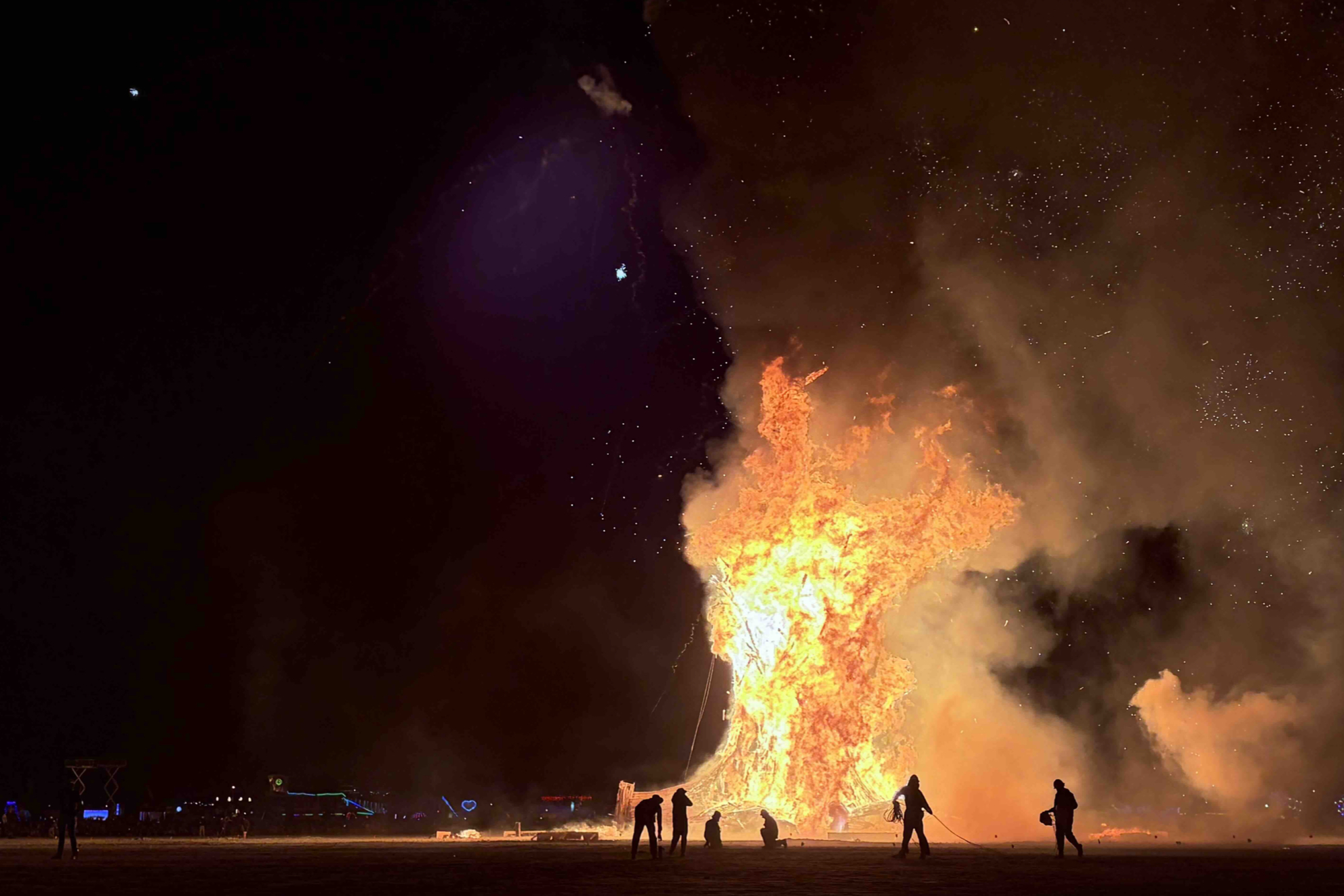
¡The Burn! Esta noche ardería The Man. Todos los habitantes de BRC asisten a la ceremonia, reunidos en círculo alrededor de la figura central. Pero antes... ¡Té! ¡Comida! ¡Risas! Un poco de ciclismo random, envío de postales (¡hay un correo!), mas baile desaforado enfrente y a preparase para la ceremonia. Ya alistados, encaramos hacia el inmenso círculo en medio de la playa. Nos ubicamos y presenciamos un show de malabares con fuego que remitía a lo mas profundo de la esencia humana: El Ritual. Y The Man ardió. Hubo fuegos artificiales. Y vítores. Y unión. ¡Y mas fiesta! El legendario Lee Burridge pinchaba a la medianoche, asi que allí fuimos. Una fiesta auténtica, llena de amor y un dejo de nostalgia. Estábamos cerca del fin ya, asi que todos dimos un poco mas de nosotros mismos. A las 2am Lee puso su último track y con eso me eché a rodar yo también. Debía desarmar la carpa y alistar mi equipaje porque 8am partía el autobús de vuelta al "default world". Intenté descansar, no pude, empaqué y al amanecer salí rumbo a la estación, donde me hicieron tirar los últimos pasos antes de darme el pasaje. Dormí todo el viaje hasta Reno. Cuando abrí los ojos, vi un cartel publicitario. Estaba de vuelta, pero ya no era un hada.

Burning man: chronicle of a fairie
For several years now, I had secretly longed to go to Burning Man, mythical event that takes place every September in the Nevada desert. There, artistic expressions of every kind blend with nature itself: sculptures, performances, music, silence… and dust, wind, rain, mud, relentless sun and benevolent moon. Nine days and nights of pagan rituals, where the 70,000 inhabitants of a temporary city built exclusively to celebrate the brightest side of humanity move about on bicycles, electric motorcycles and magnificent floats.
Burning Man, with its colossal and selfless authority, symbolizes the idealistic side of the postmodern generation, just as Woodstock defined the free spirit of the ’60s and glam/punk rock the disillusionment and decadence of the ’70s. Postmodernity spans more than a decade, reaching its peak in the ’80s, after mass social movements imploded as pop capitalism surged: yuppies, new wave, architecture of inhuman scale, the American dream of prosperity and insatiable consumerism gave rise to a Western society full of fake smiles, clever advertisements, and a pill for every problem. Freedom above all, but in isolation. Individualism as king; collectivism as an outdated dogma that hinders the supersonic advance toward the stars. And so we crash: climate crisis, oil wars, pollution, carcinogenic foods… artificial intelligence looming to take first our jobs and then us.
The early response to this state of hyper-superficiality came from a group of Californian bohemians in 1986, who—with the burning the first “Man” on a San Francisco beach—unwittingly launched a movement that soon came to be known as “Burning Man,” the essence of which lies in solidarity, unrestricted expression, and extreme self-reliance. At Burning Man, money doesn’t exist. Everything is shared, and there are no limits to the imagination. “The Burn” remained a quasi-intimate ceremony until 1990, when it moved to its current location, a desolate stretch of land known as the Black Rock Desert. There it developed in anarchy until 1997, when the first rules were imposed: no animals (they would run off into the mountains) and no liquid fuel or fireworks (explosive risk). Over time, this rather curious social experiment grew in popularity and was forced to organize itself “seriously” in order to accommodate a growing number of burners and thus continue to expand its (counter)cultural impact.

Even though money isn’t a thing, tickets are expensive. They range from $550 to $3,000—depending on when you buy them and how much you’re willing to contribute to the cause—they sell out quickly, and it’s not that easy to get them. Even with a ticket in hand, getting to the event presents an extra challenge, since it takes place in a remote location with no fresh water and very little annual rainfall. Driving there is quite an ordeal. Plus, you need to set aside several days of downtime without an internet connection, which is scarce. It’s not possible (and highly discouraged) to work remotely from Black Rock City—the evocative name of a city that springs up in a matter of days only to be completely dismantled in just as many, leaving no trace of its existence.
Knowing all this, I set out on the adventure. I was now a full fledged fairie, such is the name given to Burning Man first timers.
Although many consider this an ideal occasion to try mind-altering substances, I happened to get sick a few days earlier, so I spent the entire “Burn” completely sober. This gave me the opportunity to take in the events with absolute clarity. An Argentine friend picked me up with his girlfriend from Reno airport just after midnight and we headed out to the desert. For the last few miles, all we could see were dilapidated, wind-battered gas stations. We arrived at the line in the wee hours, where dozens of cars, pickup trucks, and RVs were waiting their turn to enter the grounds. Outside, a merciless dust storm was raging. Visibility was almost zero. It felt like another planet. After three hours, we were welcomed in. Dawn was breaking.
Entering Black Rock City is like stepping into an alternative city. Another dimension? It’s laid out in a perfect crescent shape; every vehicle has its assigned spot, there are marked streets, and you can tell that people are extremely well-prepared to live in a rather hostile environment, where even bugs don't abound. What’s striking is that every resident is in a state of constant self-expression. The first thing that caught my attention was a girl perched on a giant toad, watching the sunrise. Then I noticed a circus tent with a sign outside that read “Orgy Tent”… most people were still asleep, but reality already felt like a dream.

Day 1
I spent the morning setting up the tent at my “camp,” where a group of friends was already waiting for me. The average age at BRC is 34, but there are people of all ages, including families. The first thing I did was grab a lounge chair, set it up in the corner, and sit back to watch the incredible parade of characters, bicycles, and floats passing by. Although I consider myself an experienced traveller, I have to admit this wasn’t just any corner. After a couple of hours, we went out for a walk. A block away, we discovered a little tent serving the trendy drink: matcha. Since money doesn’t exist here, you simply walk up to the “counter” and, with the leisurely pace typical of a place where clocks are rarely used, place your order. A duo of DJ-baristas brightened up the afternoon. Divine.
The wind wouldn’t let up—in fact, it was picking up. I went back to the camp and got ready to head out. I didn’t really do anything, though, since I stayed in the same dusty clothes I’d been wearing. Taking a shower is a luxury few can afford at BRC. Plus, you’re not allowed to spill any kind of liquid. There aren’t any trash cans either: waste has to go back to the “default world” with the person who generated it. At dusk, my friend and his partner picked me up, and we rode together to one of the many parties. The nighttime outfits are a spectacle in their own right, since the temperature sharply drops: faux fur jackets, fedora-hats, scarves, animal prints, tight braids for the ladies, metal bracelets for men... body lights for everyone (if you’re not wearing lights, they’ll yell “dark bug!” at you). The general vibe goes from retro minimalism to futuristic maximalism, with no stops in between. My look? A red argentine-style poncho, black top hat, espadrilles, and a face mask to protect me from the dust. I danced for a while, but the day’s exhaustion got the better of me, and I soon went to sleep.

Day 2
I woke up early to the beat of loud electronic music. Right across the street, a tent with DJs had been set up. I walked over, and for a while I was the only dancer. The wind had died down a bit, but the dust made the air almost unbreathable. Everyone was wearing their own styles of masks, some more sophisticated than others. After sharing a meager lunch seasoned with highly alkaline dust (BRC stands on prehistoric soil), I hopped on my bike and set out to explore the city. I passed by makeshift bars, a street corner with an open mic where anyone could sing or recite whatever they pleased, an installation called “Barbie Death Camp” (??!!), and many camps set up in the most inventive ways—from military tents to silver cubicles that looked like they were meant for space exploration. I joined a gathering of “sober burners”—I was one of them, albeit by necessity—where I listened to some wild stories until a “park ranger” showed up and told us a dust storm was approaching (Desert Storm!). Everyone immediately got up, hopped on their bikes, and rode off in a hurry. What was coming?
At sunset, after the storm (it was mild), my friends came to pick me up, this time with a rope, which we used to tie my bike to their electric motorcycle. So they towed me all along the playa, the open space in front of BRC, where most of the parties take place and where large-scale art installations are set up. We were the center of attention. Needless to say, there were some very eye-catching sights, like the Titanic and the Eiffel Tower (both split down the middle), but that afternoon my guide's ingenuity won everyone’s approving smiles. We ventured into uncharted territory, where mobile DJ booths blasted electronic music of various genres, though house and tech-house were the predominant sounds. Once night fell, it started to drizzle lightly. Soon after, it was actually drizzling. I decided to head out while I still had the energy, knowing that cycling through the mud would be a struggle. I wasn’t wrong. I made two stops before getting “home”: at a psychedelic elephant that sheltered me from the cold and at the beautiful “Temple,” built entirely of wood in honor of the people we love who are no longer with us. Our wishes, frustrations, and loves are left there, so that the fire may lull them to sleep on the last night of the Burn, when that uniquely designed structure turns to ashes… I finally arrived, lay down, and immediately began to hear the heavy raindrops falling. I closed my eyes.

Day 3
I woke up and it was still raining. Our Ukrainian neighbors were playing the same Foster the People song on repeat. I stepped out of the tent and there was no longer any dust in the air, but it was a muddy mess. When mixed with water, the BRC ground turns into a sticky substance that’s hard to wash off. People were covering their shoes with plastic bags. No one was really prepared. Since the roads were impossible, the trucks responsible for emptying the city’s hundreds of portable toilets couldn’t make their morning rounds either… It kept drizzling all morning, until it started to clear up around noon.
That’s when a man appeared—wearing a poncho and a hat, with a broom in hand—to help us scoop out the water that had pooled on the tarp that was our roof. With the help of his broom, he did it quickly. He was one of the few wearing boots. “You look like a gaucho!” I said. “This is a gaucho garment,” he replied, showing us a neckscarf unmistakably from the Pampas. “I once went to Buenos Aires to learn fileteado.” Coincidence? I immediately grabbed a notepad and a marker and asked him to improvise one. He sat down, and as he drew, he began to tell us his story. “I’ve been to every Burn. I’m part of the group that came up with the idea, back in San Francisco.” The members of our camp began to gather around Justinian—such was his name. “In the ’90s, I went on tour with Trent Reznor. I did a contortion act in the middle of the show. You can see it on YouTube as ‘The Original Armenian Rubberman Justinian Morton.’” A natural storyteller, he was the one who told us what the first Burns were like and how 1997 marked a turning point, being the last one without rules. “Back then, there were only 15,000 of us,” he explained. -“I always tell everyone, go to the most sophisticated camps and use their nice bathrooms, because the spirit of Burning Man is about sharing everything.” The man exuded humility; he was preaching wisdom. A teacher. “The favor you did for us is called gauchada,” I told him. “Please write that down for me—I collect words.” I wrote it down on his cell phone as he finished his fileteado, which read ‘GAUCHO.’” —“You have beautiful firuletes (intricate patters) in your fileteado,” I told him. “Write that one down for me too,” he said after I explained its meaning. And he walked away, thanking us for listening to him, almost as if he was grateful that we’d let him do us a favor. The simplicity and magic of that moment highlights the resistance that exists today toward the Silicon Valley tech bros, who began attending—mostly as observers—about a decade ago, during the boom of their empires in the cloud, bringing with them extreme luxury and exclusivity to a space that had always been considered egalitarian, bypassing the daily efforts essential to the burning experience.

As the rain let up and the sun came out, the mud fully dried in less than an hour. There was no more dust—or wind! The party across the street was in full swing, clubbers howling after the rain. Bikes were coming and going. BRC was in active mode. I seized the chance and headed out. I walked a couple of blocks and came across a discreet but eye-catching tent: “Café Morocco.” I heard music and slipped inside. What I saw was the epitome of “chill-out:" low sofas, cushions, soft rugs, slow-tempo tunes and coffee, accompanied by female voices and instruments subtly improvising over the DJ’s mix. There weren’t that many of us, but it was packed. All barefoot. I soon realized it was a “camp party.” Everyone knew each other—except for me. Mid-afternoon bliss. As I emerged from that North African dream, the night was licking its lips.
I rushed to get ready (I just put my poncho on) and my friends came by to pick me up (again). The playa was buzzing, and the stars were coming out. We went to see Monolink, who was playing on the Robot Heart float—the most famous camp, both for the DJs it features and its level of hedonism. It was packed. We waited. And waited. And waited. The artist was there, in the DJ booth, surrounded by campers, but after an hour, nothing. A little disappointed, we biked off to another party. The nighttime scene on the playa is pure neon stretching to the horizon. Bikes, people, floats… everything is lit up, a multicolored mirage. The music from the floats blends together. It reminded me a bit of Creamfields and that chaos of beats and the flow of clubbers. Party, party, party. On the way home, I climbed a tall tree trunk with a little house on top. I sat in a hammock and watched the red moon rise, the stellar dominatrix of that surreal landscape. Everyone seemed to be under the influence of something—except me. I attentively observed “The Man,” the effigy of a man standing upright on a 30 feet platform at the center of the playa. It serves as a guide, as it faces the exact mid-center of the crescent-shaped city. I then followed his gaze and went to sleep, tired from pedaling through the rough, hardened mud.

Day 4
The Burn! Tonight, The Man would go up in flames. Everyone in the BRC attends the ceremony, gathered in a circle around the central figure. But first… Tea! Food! Laughter! A bit of random cycling, sending postcards (there’s a post office!), more wild dancing acroos our camp, and then getting ready for the ceremony. Once ready, we headed toward the immense circle in the middle of the playa. We found our spots and watched a fire-juggling show that tapped into the deepest essence of humanity: The Ritual. And The Man burned. There were fireworks. And cheers. And togetherness. And more partying! The legendary Lee Burridge was DJing at midnight, so off we went. A genuine party, full of love and a touch of nostalgia. We were nearing the end, so we all gave a little more of ourselves. At 2 a.m., Lee played his last track, and with that, I headed out too. I had to take down the tent and pack my bags because my bus back to the “default world” was leaving at 8 a.m. I tried to rest, but couldn’t; I packed up and, at dawn, headed to the station, where they made me perform the last dance steps before handing me the ticket. I slept the whole way to Reno. When I opened my eyes, I saw a billboard ad. I was back, but not a fairie anymore.

Texto y fotos: Fred Wood (2026)