
By Marcela Meignan
How much space can a photograph give a garment? It has a flat surface and a fixed boundary. Yet a fold can seem to advance towards us, a sleeve can become an enclosure, and the interval between cloth and body can feel almost architectural. Fashion photography makes some of its most interesting decisions in that interval.
PENN & FASHION, at the Maison Européenne de la Photographie in Paris from 30 September 2026 to 17 January 2027, offers a reason to return to those decisions. Its chronological span, from 1947 to 2008, includes Irving Penn’s collaboration with Issey Miyake. The encounter between a photographer’s frame and a designer’s construction is a particularly useful place to begin.
Distance as a working method
The Miyake Design Studio’s account dates their sustained collaboration from 1986 and describes a striking arrangement. Clothes travelled to New York, where Midori Kitamura styled them for Penn. Miyake did not attend the sessions. The designer allowed the photographic interpretation to develop without his intervention.
That separation changes how we might understand the resulting image. The photograph is not simply a designer’s instruction executed by another hand. It becomes a reading of the garment, with its own choices of proportion, emphasis and relation to the body. The distance between the two studios creates room for another author.
There is a lesson here for fashion imagery today. To communicate a design does not necessarily mean repeating its runway appearance. A convincing image can discover a relationship that is difficult to see in motion, or hold a shape long enough for its construction to become a subject in itself.
The space inside the clothes
Miyake’s official account of his work places the body, cloth and the space between them at the centre of his approach. This offers a precise alternative to treating clothing only as a surface attached to a figure. The gap is part of the design. It allows volume, movement and a changing relationship with the wearer.
Photography must translate that gap into signs. An opening can reveal depth; an overlapping edge can establish which plane comes forward; a shift in tone can make a curve readable. When these relationships become clear, the viewer can imagine the garment as something more complex than its outline.
But clarity is always selective. Showing a shape also means choosing an angle and concealing others. The strongest fashion image does not give us exhaustive information about an object. It proposes a way to understand it.
Read the edge, then the surface
The MEP’s selection includes Penn’s 1967 Balenciaga Roses Dress and his 1988 image of a Yves Saint Laurent cape with a Braque-inspired design. They suggest two productive questions for looking: where does the silhouette end, and what happens within that boundary? The exhibition’s emphasis on volume and texture invites us to keep both questions active.
An edge can make fabric seem emphatic, almost independent of the person wearing it. A surface can complicate that certainty. Ornament interrupts the eye; a pattern moves across a bend; an area of darkness leaves a shape unresolved. The photograph holds these different readings in the same frame.
Looking slowly means resisting the impulse to identify the designer and move on. Try following one contour before reading the whole figure. Then reverse the process: look at how a detail alters the larger composition. The image becomes less a badge of taste and more a structure that can be examined.
A frame is an interpretation
The exhibition brings together work from the MEP, the Nicola Erni Collection and loans from The Irving Penn Foundation and the Miyake Issey Foundation. Those institutional contexts matter: the fashion image is encountered here as a collected object, beyond its original editorial or commercial setting.
That shift should not erase the people and decisions involved in its making. The designer gives the cloth a form. Styling and the wearer establish another relationship. The photographer selects what the frame will let us see. An image can be persuasive precisely because these contributions are not identical.
Penn and Miyake’s collaboration makes that difference worth considering. Clothes do not lose their construction when they become images, but construction must be read anew. What reaches us is a proposal about volume, held still long enough for us to question it.
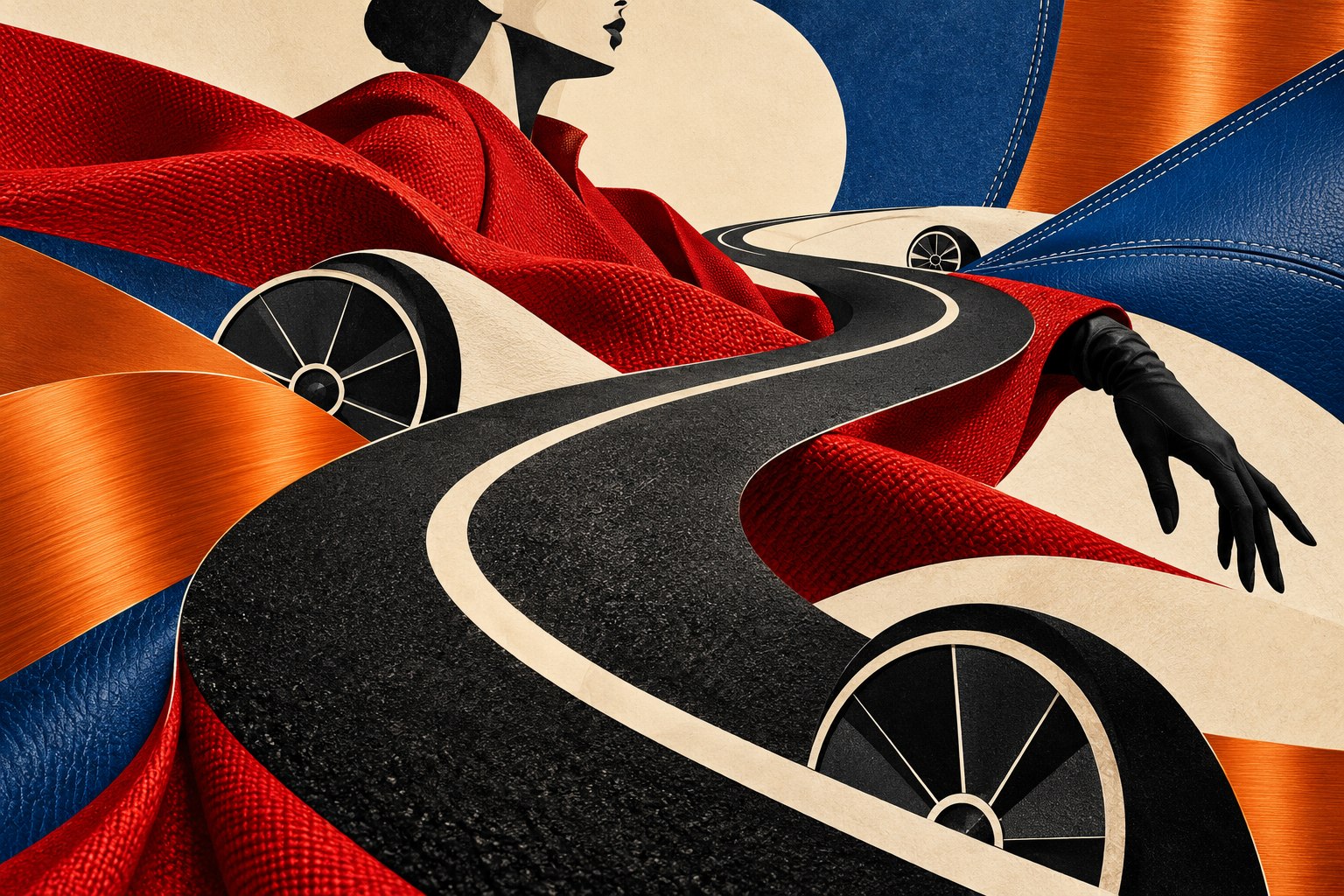
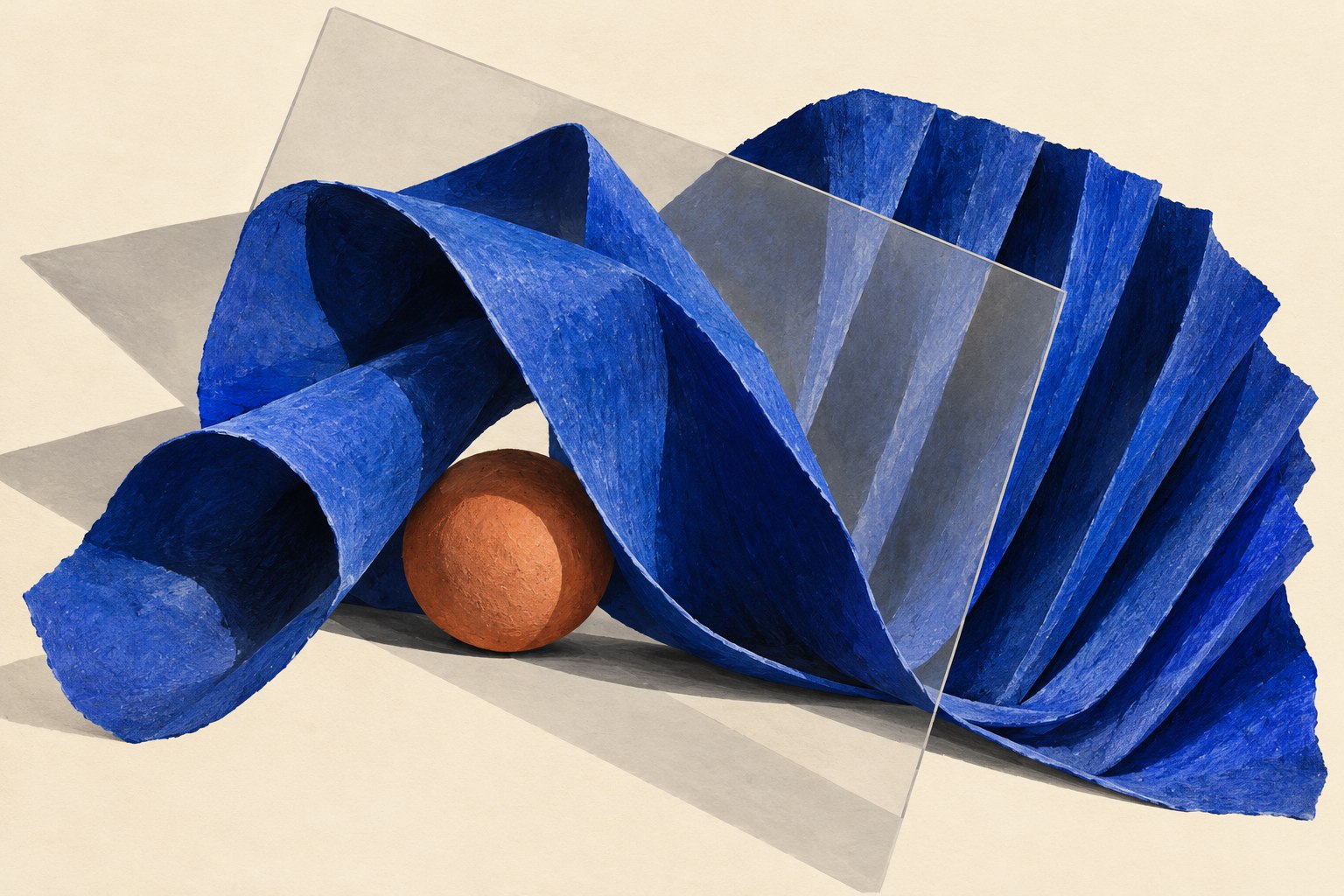
Visual: original REGIA conceptual illustration, created with AI assistance. Invented abstract volumes; this is not an Irving Penn photograph, an Issey Miyake garment or a view of the exhibition.
Sources & links
- MEP — PENN & FASHION: dates, works and collections.
- Miyake Design Studio — The Concepts and Work of Issey Miyake, including the Penn collaboration.
- The Irving Penn Foundation — Fashion gallery.
- ISSEY MIYAKE — official website.
Written from the official exhibition and studio resources consulted on 30 October 2026. Visual readings are editorial analysis; no interview or attendance at the exhibition is implied.