
By Marcela Meignan
A collection can be a room full of possessions. It can also be a way of thinking. The difference becomes visible when an object is brought into relation with another: a pocket beside a print, a familiar character beside an unfamiliar material, a piece of workwear reconsidered as a proposition about proportion.
That is the productive question left by NIGO: From Japan with Love, which ran at London's Design Museum from 1 May to 4 October 2026. With the exhibition now closed, its documentation offers a useful way to look beyond the desirability of the individual object and towards the work of selection. What happens between finding something worth keeping and making something new?
The archive is a relationship
The museum brought together vintage clothing, personal objects and NIGO's designs, placing the collection alongside the career. This was a significant curatorial decision. An archive presented only as a succession of prized acquisitions can tell us what somebody owns without helping us understand how they look. A dialogue between collected pieces and designed pieces asks a more demanding question: what carries across?
It might be a scale, a construction or a way of placing an image. Recognising a reference is the beginning of that reading. The interesting part is the distance travelled: what has been retained, what has been removed, and what has acquired another use. Collecting becomes a design method when keeping an object makes it available for another decision.
The exhibition's documented reconstruction of NIGO's teenage bedroom gave that process a domestic starting point. Rather than imagine a fully formed creative identity arriving on the runway, it located the story among things encountered and preserved. The room mattered as a context for attention, before it became material for a museum.
A garment is more than its graphic
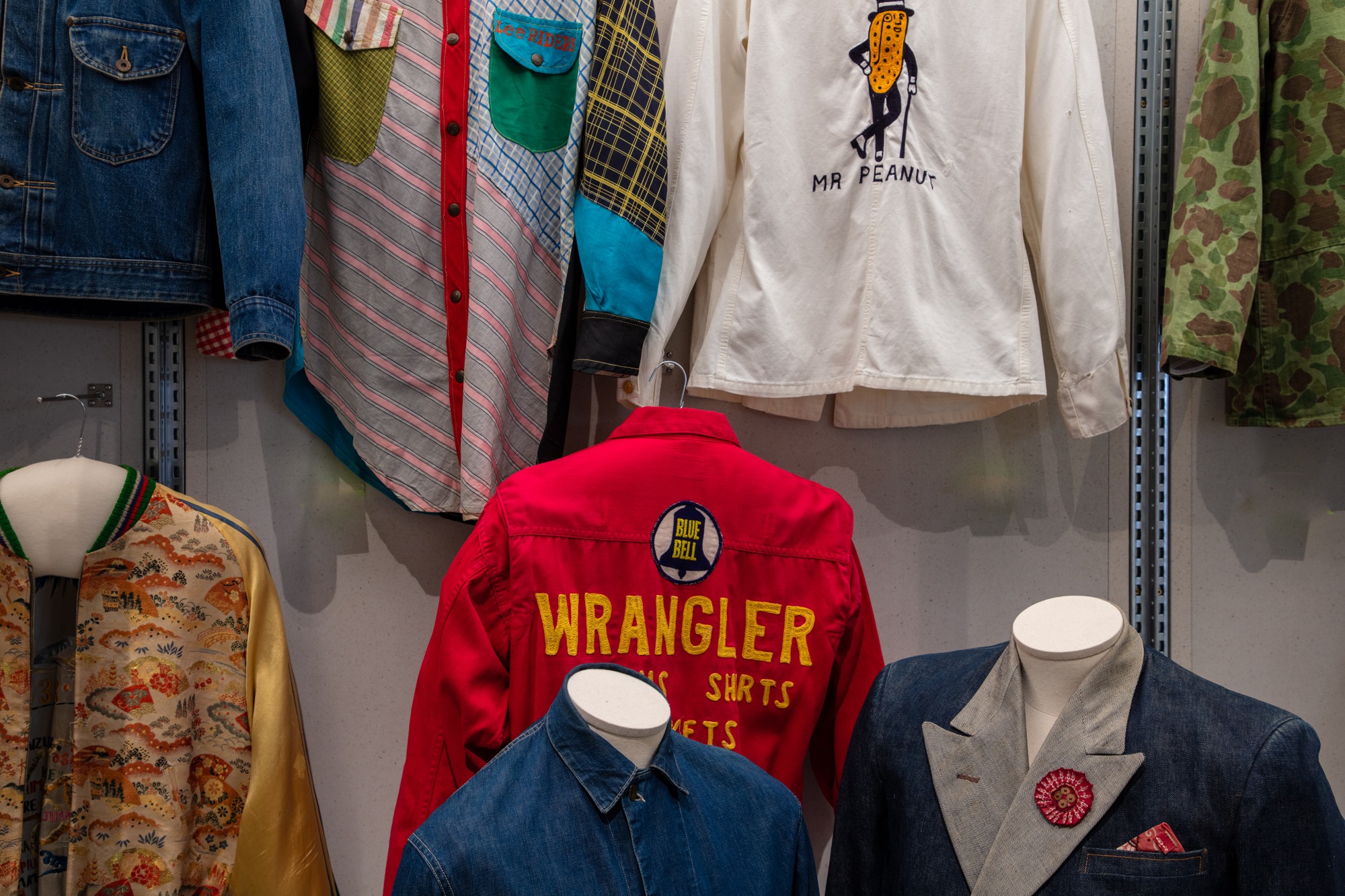
In Luke Hayes's installation photograph, denim, a multicoloured shirt, a character print and an embroidered red jacket occupy the same field. The picture rewards a slower look. A graphic competes with a seam; a pocket interrupts a stripe; a patch changes the balance of a surface. These are observations about the display, not a claim that one particular garment directly generated another.
That distinction is essential when discussing a designer associated with recognisable imagery. It is easy to turn a practice into a list of symbols. It is harder, and more useful, to consider the ordinary decisions that make those symbols work on clothes. Placement changes an image. Fabric changes its weight. Repetition can turn recognition into a language, but repetition alone does not guarantee an idea.
In this reading, the archive is neither a recipe nor a certificate of authenticity. It is a field of possible comparisons. Its value depends on the specificity of the questions brought to it.
The collector and the producer
NIGO's career makes that relationship particularly charged. LVMH's presentation of the retrospective places his work across fashion, music and design. He is not simply a collector looking at a culture of products from the outside; his own design practice has helped supply it.
There is a tension here worth preserving. The language of the rare object can encourage attention to an unusual detail. It can also reduce judgment to access: who acquired it, how difficult it was to obtain, whether somebody else has one. A critical account should resist treating scarcity as an explanation of design quality.
The more revealing test is what an object allows the designer to notice. Does its construction lead to a new relationship between parts? Does a familiar image become strange when moved? Does a historical reference open a possibility, rather than close a garment inside a period costume? These questions are more durable than the excitement of possession.
When the hand changes the pace
The retrospective also included ceramics made by NIGO and a glass tea house created for the exhibition. These elements expanded the account beyond the wardrobe. The museum's opening press release describes a final section devoted to his engagement with Japanese craft and ritual.
It would be too convenient to present craft as an escape from commerce, or as proof that one field is more sincere than another. A better reading is that working in another medium changes the decisions available. A vessel has to be understood through its volume, edge and contact with the hand. Those demands redirect attention without requiring us to invent a private motive for the person making it.
That is what makes the exhibition's broader proposition useful after its closing date. The most persuasive account of a collection is not the story of having everything. It is the story of learning to distinguish: one surface from another, an effective reference from an easy one, a meaningful transformation from a recognisable repeat.
Collecting, understood this way, is an education of the eye. Design begins when that education becomes a choice.
Cover: installation view of NIGO: From Japan with Love at the Design Museum, London, 2026. Photography: Luke Hayes. Image supplied in the Design Museum's official press materials for the exhibition. This article is based on published exhibition documentation; it does not claim an on-site visit or an interview with NIGO.
Sources & links
- Design Museum — NIGO: From Japan with Love: exhibition overview, dates and image credits.
- Design Museum — opening press release, 28 April 2026: archive, exhibition structure and craft section.
- LVMH — NIGO at the Design Museum in London: institutional perspective.
- KENZO — official house website · HUMAN MADE — official label website.
- Design Museum — Press Office: official photographic materials, installation image 1, credited to Luke Hayes.