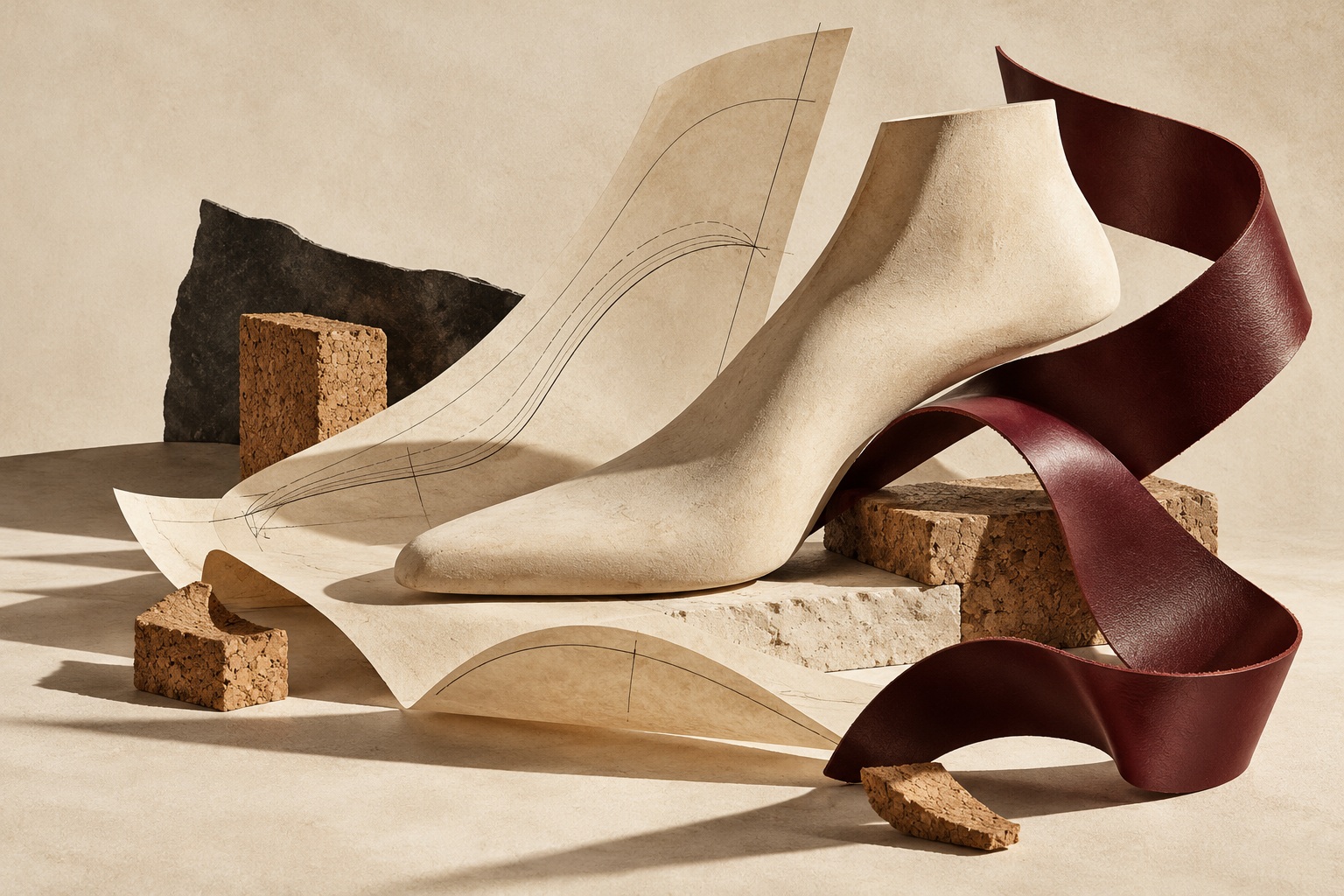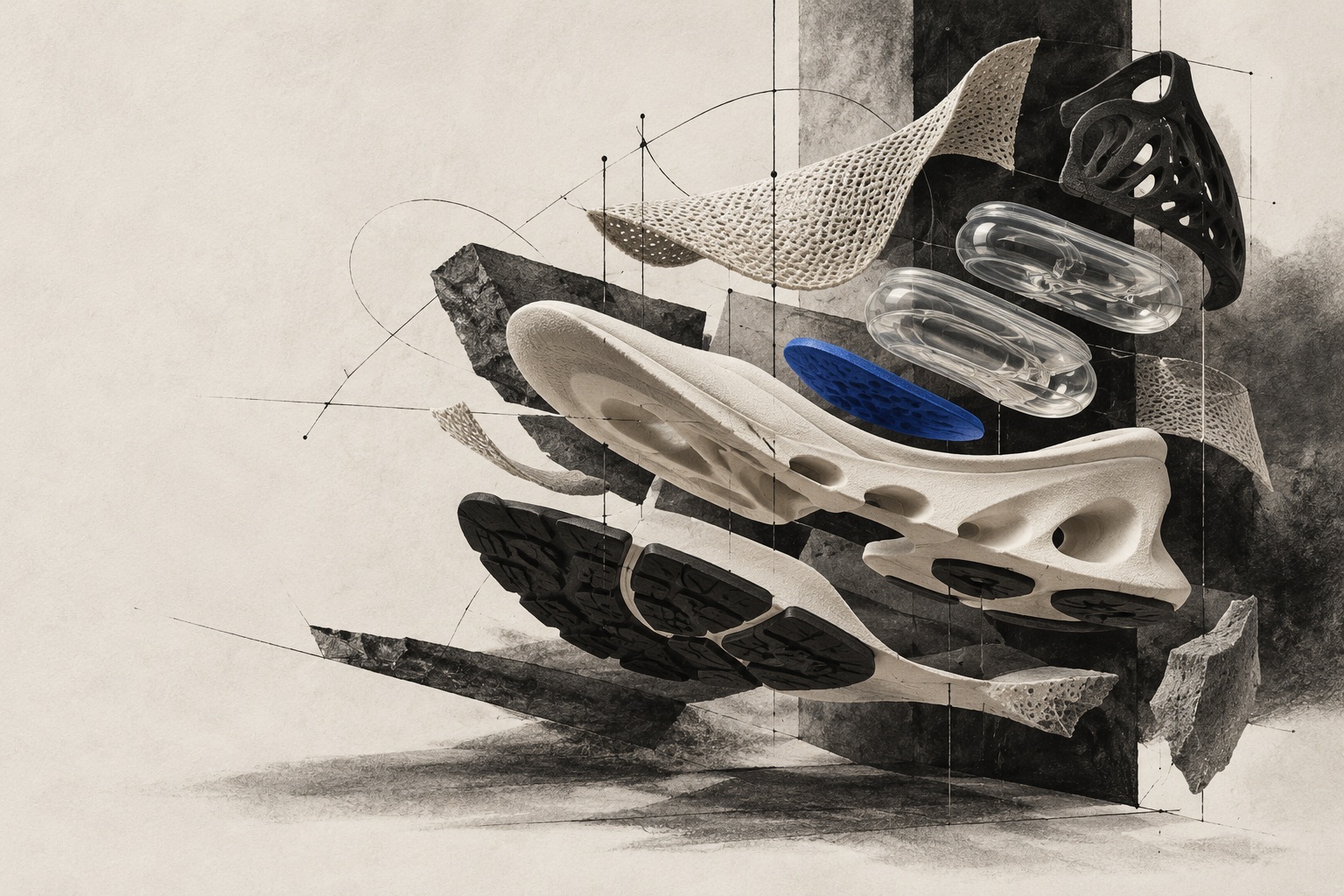

A prototype holds a different kind of glamour. Before a sneaker becomes a recognisable silhouette, it is a question about the body: what needs support, what can become lighter, what should happen when a foot meets the ground?
Header: original AI-assisted conceptual illustration created for REGIA. It does not depict a Nike product, archive object or exhibition installation.
The polished product image offers certainty. Every surface belongs where it is. An experimental object invites a more searching look. Its interest lies in a decision still becoming visible: a structure tested, a material considered, an idea given enough form to be examined.
That is a compelling entry into Nike: Form Follows Motion at New York’s Museum of Arts and Design. Organised by the Vitra Design Museum, the exhibition brings design studies and experimental footwear into the same conversation as familiar finished models. Glenn Adamson is its curator, with Marcella Hanika as assistant curator.
Looking before recognition
The museum’s press material singles out an early mechanical Shox prototype dated 1981. Its value as an editorial starting point is the invitation to look at an experiment before approaching a product through recognition. What problem was being made tangible? Which part of the object asks for attention?
Those questions change the pace of looking. A seam can be considered as a means of joining. An opening can become a decision about space. A sole can be read as a structure between a moving body and a surface. The shoe begins to occupy a larger field of inquiry than its outline alone suggests.
Fashion is particularly good at making outlines memorable. The prototype allows another form of attention: following the labour that makes a form possible. It asks the viewer to remain curious before deciding whether the result is desirable.
When a function becomes a visible language
In MAD’s account of the exhibition, the Air section includes Frank Rudy’s testing equipment and air-bag prototypes. The museum connects these objects to the visible Air sole of the 1987 Air Max. The passage from an internal mechanism to a feature that can be seen is especially revealing.
Once a technical element enters the appearance of a shoe, it becomes available to the eye as well as the body. It can be recognised from a distance, enlarged in an image and incorporated into a personal style. Performance and visual identity meet in the same detail.
That does not make every visible technical feature evidence of better performance. It gives criticism a useful distinction to preserve: what a design does, what its appearance communicates, and what a wearer makes of it. Those relationships deserve to be examined rather than collapsed into a single story of progress.
The archive keeps the questions open
The Vitra Design Museum’s accompanying publication places footwear and apparel within a broader design culture, bringing archival material together with research into the body and the spaces where products are developed. It offers a way to approach the finished object through the systems around it.
For a fashion reader, that shift is productive. Desire can begin with curiosity about how something was made. A prototype need not be beautiful in the conventional sense to hold the gaze; a visible question can be as absorbing as a resolved surface.
An exhibition built around a company archive also presents a selected account. The objects are evidence of particular experiments, while the narrative connecting them is a curatorial construction. Keeping that distinction in view allows appreciation to coexist with scrutiny. A history of material research, for example, cannot by itself establish the environmental impact of a current product.
The unfinished object gives the viewer somewhere to begin: with the junction, the layer, the support, the thing that has yet to become familiar. Before the hype, there is a decision about form. Looking closely can make that decision interesting again.
Nike: Form Follows Motion, Museum of Arts and Design, 2 Columbus Circle, New York. 12 September 2026–7 March 2027, according to the host museum’s published programme.
Sources & links
- Museum of Arts and Design — current exhibition and curatorial credits
- MAD — official press release, dates and objects discussed
- Vitra Design Museum — accompanying publication
- Nike — official website
Written from the institutions’ published materials; no on-site visit or original interview is claimed. Header illustration: REGIA, AI-assisted conceptual artwork. The abstract components do not reproduce or document actual Nike prototypes.