
From the archive — REGIA No. 46, W22 / 2022. Digital republication, 25 October 2026. The interview below reflects the time of its original publication; relative dates and projects refer to 2022.
Interview: Marcela Mayorga
Text: Julian Doyle
Photography: Gato Suaya
Stories from the City, Stories from the Mountain
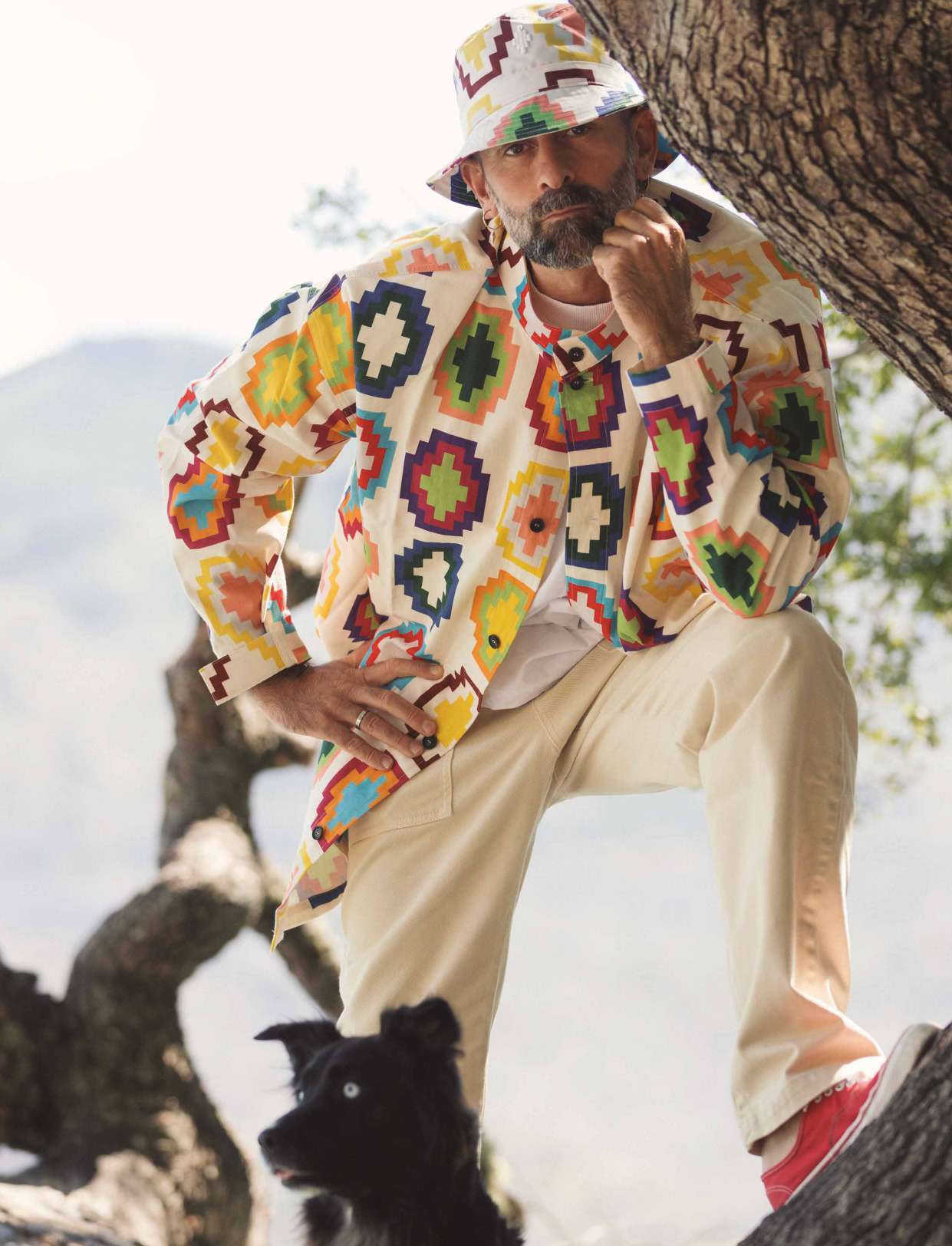
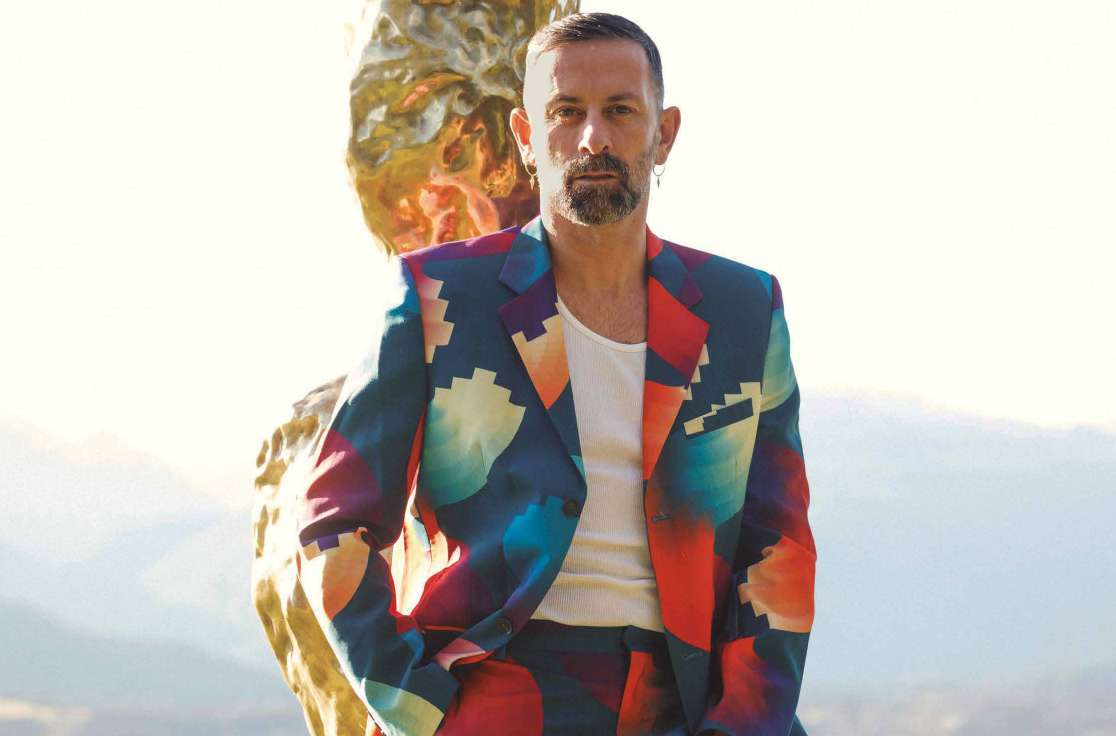
For Marcelo Burlon, his status as an outsider is part of a legacy that over the last decade has led him to produce collections that are inspired both by the street and by nature, channeling an intoxicating balance of technical precision and a striking drive that distorts the limits between the cultures of mysticism, psychedelia and networking.
— I come from an Italian and Lebanese family. I was born in El Bolsón, in Patagonia. It is a very special place in Argentina, surrounded by lakes and mountains. When I was 14, my family moved to Italy, to the Riccione area, known for its vibrant parties scene in the ‘90s. People came from all over the world for the partys because the best clubs were there. Club goers always went to great lengths to have the best outfits. The textile industry was also in that area, so we had Marc Jacobs coming there to produce their collections, Jean Paul Gaultier and other designers.
Two of his greatest inspirations, the nocturnal pulse of 90’s clubbing and the powerful geometry of the Patagonian indigenous people on death, life, sky, earth, nature, Pachamama, are the worlds that Marcelo Burlon managed to skilfully synthesize , leaving a global mark, inventing their own symbolism to capture the spirit of the clubs and the energy of a rave.
— My grandfather was an Italian tailor in Buenos Aires. During that time my father was a truck driver and one day he traveled to Patagonia, his truck broke down and he met my mother in El Bolsón. That’s where my brother was born and then me. My mother was the pioneer of tourism in Patagonia, the one who began to promote the area that later exploded. In 1990, with all the crises happening in Argentina, my family decided to move to Italy, we sold all the licenses we had here from the kiosk, the laundromat and the travel agency, we left the house and the rented premises, and we were off to a little town in the center of Italy, on the Adriatic Sea to start from scratch, to work in factories, to clean hotel rooms with my mother on the weekends, to work as a waiter... very different in relation to the comfortable life we had in Argentina . That’s where you grow by force, the value of family and money mature, and you start to grow with another mindset, with another conscience. When someone so young begins to contribute to the family to be able to pay the rent, to be able to eat, you give a different value to things.
He grew up in the clubbing scene on the Adriatic Coast, and then, when he moved to Milan, he became part of a group of graffiti artists who were very influential at the time and deeply embedded in street culture. Beyond the south, his personal history is linked to the north and more precisely to the city of Milan. It is not by chance that his brand was called the County of Milan. The setting is the unbridled Milan in the late 90s and 2000s, where fashion, subcultures, nightlife and clubbing intertwine and that led to the start of streetwear that started the domino effect that ended up reinventing the entire fashion system. He was one of the key players in this revolution.
— I no longer did drugs, the moment of ecstasy was very short but very important, very intense because it opened other doors for me. At the same time I began to practice Buddhism with my mother and that requires you to clean your entire environment, my friendships began to change, to grow. Suddenly, in 1998, after working in clubs for several years, a group of guys from the club who were traveling around Italy came to the town where I lived, which was having a film festival at the time, and they said to me: “What are you doing? You should come to Milan!” They were all models or fashion designers for big companies like Prada, and they were all young like me. And they had amazing jobs, so I thought, “Yeah, let’s do it.” There I immediately started working in a very important club called Magazzini Generali where all the Italian designers went, Domenico Dolce, Stefano Gabbana, I met Riccardo Tisci and I started doing his public relations, the Nous brand that had hired me as a model. Asked me to do PR for them, so overnight, I began to get to know the whole city of Milan.
Burlon repeats it in each of his talks he gives at universities: “I didn’t go to university.” Everything he did in his life, and everything he does now, is self-taught, from his passion for DIY, and the pursuit of the things and people he loves.
— My experience did not come through study but through work, through work experience in the place itself. What happened was that I was immediately able to create a character for myself, which was me, the Marcelo of parties, and that ended up giving me credibility. And it also happened by being in the right place, at the right time. I knew that somewhere I was going to be famous, that I was going to be successful somewhere, how when or why I didn’t know, but I felt that my life was going to explode at some point in exposure, fame, wealth and everything else that came later. But apart from this, my goal was never to have money but to do beautiful things that do me good. I left Dolce because I didn’t feel well, and so I continued to live in my little house with no money to eat or pay for the bus, but I did so because I knew that my well-being came first.
From his work in the events and nightclubs, he built an interesting international network of musicians, designers, stylists, DJs, and every time he flew to a different country or city, people from the scene would go to see him. He soon realized that these people didn’t want to just have a one-night stand with his music, they wanted to be a part of his life in some way.
— Shortly after I started my public relations company, I did the Gucci party, the Versace party… I was the one who was connected with the brands, so everyone who wanted to launch something, a perfume, open the store, used to call me, because I had the best people in town. That means a very versatile type of people. My first big event was for Giorgio Armani, I organized his 25th anniversary party. They called me because I knew all the cool kids. I brought the drag queens, taggers, etc. For many years, as PR I had a monopoly on all the events in Milan, there wasn’t a party that was not organized by me. I also started working as a DJ when there was already a lot of drugs in the mega clubs and I wasn’t interested, together with the PR of Miu Miu we decided to open another club called Rocket Club and on Tuesday nights we brought 300 people from the fashion world and streetwear, just at that time the first iPods were launched, so we had playlist battles with designers, I also started DJing, that was in 2003, and from there it became the iconic party in Milan. At the beginning, brands still needed characters like me, because social media did not yet exist, so it worked as a bridge between the brand and the consumer, it took the place of what are now called influencers, you could say that I was a pioneer of influencers.
The system was always his obstacle, of which he never wanted to be a part. An outsider who arrived with a different way of communicating, with a different fashion from what the big luxury houses were presenting, with a completely different spirit and energy.
— Independence annoys. I was always very independent and always supported and worked with independent projects and designers, that is, people who built themselves, who did not have family support with five surnames. I always fought for it. At the beginning it was very difficult for me in Milan to make people understand what I was doing, because they were not used to someone doing many different things at the same time. It was only when a New York Times video came out talking about my story, even before the brand started, that Milanese understood that I was multitasking in this city. It was very complicated, they didn’t understand why I did so many things at the same time: I was a stylist, a DJ, I organized events, I made music for shows of other designers, so people got very confused or they were not yet ready to accept the figure of a multitasker.
Collaboration is one of the key to Marcelo Burlon’s creative output. While his own label, which is heavily inspired by his Patagonian heritage, has partnered with brands like Kappa, Swarowski, Disney, NBA, Moet Chandon, Timberland, and Reebok, Burlon himself was one of the forces behind the New Guards Group, a kind of urban clothing production force founded with Davide de Gilio and Claudio Antonioli. Together, they’ve worked with brands like Virgil Abloh’s Off-White, Heron Preston, Palm Angels and Unravel, helping new rule-breaking creative directors bring their ideas to life.
— I met Virgil at a club in Paris where he was DJing and he told me about some problems he was having with his brand name Pyrex and about a new project and that he was looking for someone to help him do it. I told him to come to Milan, because I had a very incredible experience with my partners who helped me get my brand off the ground. So I brought him to Milan and there we created Off-White. So we started to bring new brands and new ideas to the group, the idea was to bring or create brands that are not related to fashion. So creative directors who come from music, technology or architecture, people who come from different fields. And that represents the world today because there is a lot of freedom out there. Today, despite its huge popularity, County has always remained focused on the community that surrounds its founder. More than a fashion brand, Burlon’s creature is a collection of different influences, whose vision is expressed both in streetwear and public relations but also in photography and music, a long story that is told for the first time in the book Marcelo Burlon: County of Milan Confidential, released in 2021 and written by Angelo Flaccavento with design and art direction by MACSIOTTI.
— There are 500 pages, we worked for 5 years and it was edited by Rizzoli. It was incredible to collect what happened in 45 years of life because it is not only about my work but there is a lot on a personal level, each page was very well thought out to tell my story. After so many years of work, of following a dream, when one manages to live from summer to summer like I do at this moment, it completely changes the quality of your life and also changes the quality of your environment, of your relationships. It is no longer surrounding yourself with people who drain your energy because they want to be part of your environment for being cool, but rather they are deeper people, and more sincere, more intimate relationships are created. And the link is not only fashion but art, music, the experiences of each one.
Only 40 lucky guests were invited, to what was the launch of Marcelo Burlon’s new charitable foundation in July of last year. The event was held in his second home (the first is on El Hoyo hill, protected by the foothills of the Andes) full of art in Ibiza. As for the main protagonists, these included Arca, who directed the concert, and Weirdcore, who directed the resulting filmed exploration of more than 40 hours, which can be seen online by anyone who donates a sum, however small. To one of the causes of the new foundation: the Casa Marcella trans shelter.
— I had already done several charity projects but I needed to have a more important base and not to be a private individual but to have a more important project. For the launch we did a festival curated by Arca at my house in Ibiza, 40 guests, we took away all their cell phones and gave them a state-of-the-art camera. We also asked them if they were going to use drugs that they should be inclusive drugs like LSD. So the result was a footage that all the guests recorded with more than 40 hours that ended up being edited into an hour-long video art. We launched it online and in order to see it, people had to donate between 5 and 100 euros. And with that money we raised we helped open Casa Marcella, a shelter and charity in Italy that offers safety and protection for those in transition and that we have started to support. And there are also LGBTQ+ initiatives that we are financing. Now we are working on another project together with the Argentine photographer of National Geographic, Alejandro Chaskielberg on four books. We have already started with the first one about the fire in Patagonia, which works as a book-denouncement in the framework of the climate change that is happening and affecting water, air, land and fire. With the money that we will raise, we will help families rebuild their homes.
Sources & links
Original source: REGIA Magazine, Issue 46, W22 (2022), printed pages 36–47. English print version transcribed for this digital archive; print line breaks and word hyphenation have been normalised. Original credits preserved. Translation credit in the issue: Google Translate, edited and proofread by Rosalia Martinez Castillón.
- Marcelo Burlon — official Instagram listed in the issue
- County of Milan — official Instagram listed in the issue
- Explore and order the REGIA print editions